


Nick Gordon attended Timberlake from 1985 to 1987, earned his Pioneer rating, and went on to become one of Hollywood's most accomplished independent film producers. His latest film, The Brutalist, won three Academy Awards, four BAFTAs, and three Golden Globes including Best Motion Picture Drama. His son Pierce is a Timberlake alum (2019–2023) and was part of the Rangers cabin featured in the NPR documentary Boys of Summer. Pierce will return to Timberlake this summer as a counselor.
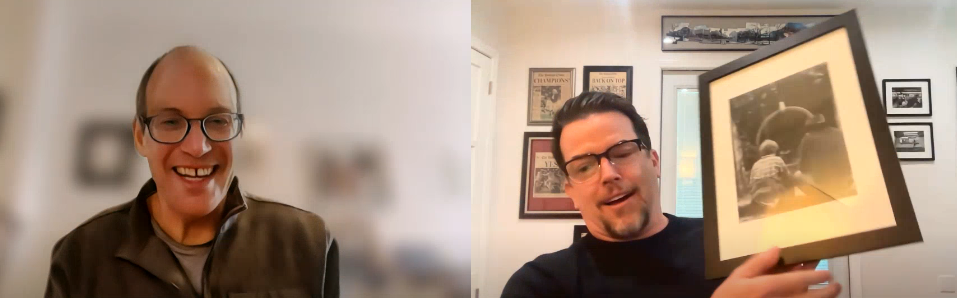
I love it when two things apparently contradictory turn out to be complementary. Nick Gordon keeps a framed photo of legendary Timberlake staff Dan Wolfson on the wall of his home office in Los Angeles while across the room, somewhere nearby, sits a Golden Globe. Remembering Nick as a camper while I was on staff in the 80’s, I wanted to learn if there was a connection between his career path and those early off-grid summers at Farm & Wilderness.
Nick Gordon is a film producer — the kind who makes big, ambitious, difficult films that many people in Hollywood wouldn’t touch. His most recent, The Brutalist, is a three-and-a-half-hour epic about a Holocaust survivor and visionary architect chasing a distorted American dream. It swept awards season, collecting prizes from the Academy, the BAFTAs, and the Golden Globes. Before all of that, he was an eleven-year-old kid from Cambridge, MA, who got dropped off at a camp in Vermont and had his life changed.
I sat down with Nick to talk about his years at Timberlake, what it takes to make it in Hollywood, and why — as a parent, a producer, and a person — he believes in what Farm & Wilderness does more than ever.
Let’s begin with: “It Changed My Life"
Nick came to Timberlake the way many kids do — not really knowing what he was getting into. His stepfather, Tom Franklin, had three children of his own who had all attended Farm & Wilderness camps going back to the early 1970s. His stepsister was among the first female Pathfinders at Indian Brook. When Nick was eleven, Tom simply said: You're going to this camp in Vermont.
"I didn't know what it meant," Nick recalls. "I had just finished sixth grade in Cambridge. I grew up as a bicoastal kid — my parents separated when I was four. My mom was in Cambridge, my dad was in Santa Cruz. I was an only child. My parents were both from Australia, so I had no blood relatives in the Western hemisphere other than my two parents. I was very independent. And I just sort of rolled with whatever came my way."
What came his way at Timberlake was something he hadn't expected.
"Pretty much instantaneously, it just changed my life. Walking into an open-air cabin, seeing the wooden bunks, meeting all the boys, looking out onto the waterfront — it all just kind of took your breath away. I felt very strongly the sense of community. I felt supported by my counselors and mentors. Being immersed in this community of boys and men together was huge for me as an only child."
He still remembers his counselors by name. Matt Janger, who read The Princess Bride aloud to the cabin every night before bed. His other first counselor was Amos Glick who went on to become a professional actor. His biggest role model at camp was Dan Wolfson — "that guy was just everything to me."
"It felt like a place where a young kid could thrive and spread his wings and learn and grow. All the things."
Nick’s “Pioneer Rating” and What That Means
The Pioneer Rating at Timberlake and Firefly Song Camps recognize both skills and leadership development. Nick earned his Pioneer rating in his second summer, when he was in Otters at Big Lodge at the age of twelve. He believes he may have been one of the youngest campers ever to receive it at the time — a distinction he offers with characteristic self-awareness: " I think in that era, I was pretty young for it."
But what the Pioneer rating gave him wasn't just a credential. It was evidence.
"That first summer I was just feeling out what the possibilities were. But it was my second summer that I really started going for it. Things like the map and compass “Get Lost” hike — you're twelve years old and you get dropped off a few miles from camp. You're perfectly safe, they're monitoring you. But you feel this: I have to figure this out. I have to bushwhack my way back to camp before dinner. And it's just so confidence-building. It gives you this belief in yourself — that you're capable of much more than you thought."
He came back for a third summer but didn't go for his Pathfinder. He was heading into high school, and the seasons were shifting. Still, he's clear-eyed about what those three summers gave him.
"I think, I think that the drive and the determination — I keep coming back to this phrase about believing in yourself. I got that at Timberlake. I just did."
The Backstory: From Cambridge MA to Hollywood LA
After Timberlake, Nick's path moved through Cambridge Rindge and Latin — where he was a classmate of Matt Damon and Ben Affleck, shaped by an extraordinary drama teacher who made all of them want to work in the arts. He went to Harvard, did theater, took a screenwriting class with Spike Lee. He moved to New York, then eventually to Los Angeles, initially to be a writer.
"Being a screenwriter writing feature films is a feast-or-famine thing," he says. "You write spec after spec after spec and hope you sell something. I found it very challenging."
What kept him going, he says, traces back to Vermont.
"I would like to think that the perseverance to stick at it — a lot of that came from Timberlake and F&W. I just think I would be a different person without it."
He eventually met his business partner, and together they built Brookstreet Pictures, which they've now run for fifteen years. Over that time, Nick has produced ten or eleven feature films, growing from low-budget genre work to major independent productions featuring the likes of Ralph Fiennes, Jessica Chastain, Michael Keaton, Al Pacino, and Adrien Brody. He just produced Michael Cera's directorial debut, and recently wrapped a film about young Richard Burton.
"It took a journey," he says simply. "This doesn't happen overnight. You really have to stick to it."
There's a phrase from Farm & Wilderness that he returns to often, one that has guided his professional life: Work is love made visible. (from “The Prophet by Kahlil Gibran)
"That really speaks to me. My job is kind of non-stop — seven days a week, twenty-four hours a day. When I was making The Brutalist in Budapest, our shoot day would end just as LA was coming online because of the time difference. I'd be on the phone with agents till three in the morning. But for me, it's about the quality of the work. You can't execute at the highest level if you're phoning it in."
And Now...Do I Send My Son To Camp?
When the time came for Nick's son Pierce to think about summer, there was never much question about where he was going.
"I was very adamant that he get a taste of this. In the modern age, where we're just inundated with nonsense all the time — social media, phones, all of it — it's more important than ever."
Pierce attended Timberlake from 2019 to 2023, a run that included his first summer just before COVID shut camp down, and then the remarkable arc of returning and continuing through to his final year in Rangers cabin. That cabin became the subject of Boys of Summer, the NPR documentary filmed at Timberlake by directors Mito Habe-Evans and Annabel Edwards. This summer, Pierce returns to Timberlake as a counselor.
Reactions to Boys of Summer Documentary
Watching Boys of Summer as both a parent and a former camper was, Nick says, deeply moving.
"I feel like they probably could have told a hundred different stories. What they chose to focus on is so important and so essential. I thought they did an amazing job. The distillation of the crucial importance of a place like F&W — I know it's not just for boys, I know that — but boys are kind of a mess right now. We read it every day. There's a new article in the New York Times about how boys are struggling."
He speaks from experience on both sides of the lens.
"You say the wrong thing to a kid you have a crush on, and before you know it she's posted something and her friends are reading about it and laughing at you. There's this spiral effect. You feel like you're living in a glass house — literally just trying to figure out your way. That creates even more importance for places like Farm & Wilderness, where a kid can leave his phone behind and spend six or seven weeks in the woods."
One moment from the documentary stood out to him above all others.
"That moment on the rock climbing wall — the counselor encouraging a kid to keep going. That's F&W in a nutshell. Not in an oppressive way, not 'I'm not letting you quit.' Just very gentle, very nurturing and supportive. That's TL right there. That was very special to see."
On Vulnerability, Success, and the Values That Travel
On the surface, Farm & Wilderness and Hollywood couldn't seem more different. One is deliberately simple, rooted in the woods and shared community. The other is brash, relentless and self-serving. Nick has thought about this tension.
"There's certainly a lot of superficiality and a vapid nature to this industry," he says. "But for me, it's about the work. And trying to operate with integrity — which I know is another very prominent value at F&W."
He doesn't use social media. Never has. He's never been on Facebook, Twitter, or “whatever it's called now”.
"If somebody wants to talk to me, they can call me. I'm much happier to meet for coffee and talk face to face. I think some of that also comes from my years at F&W — just the connection to other people and to the world around you. Going out into the woods and sitting quietly with your own thoughts. Giving yourself space to think. That's so important, now more than ever."
When asked what he hopes educators and youth development professionals will take away from Boys of Summer — which is heading to SXSW EDU — Nick offered something genuinely hopeful.
"We're not born with this frenzied, fractured attention span. We succumb to it. And I think one of the things F&W offers — one of the things the documentary captures — is that every kid is an actual living, breathing human being. The protagonist in their own story. We're so quick to categorize people based on a tweet or a post. It's not fair to them. It's not fair to yourself.
"But a place like F&W creates a space where you're fighting those tendencies in a very natural, organic way. Going back to simplicity. Compassion. Listening to one another. And it's amazing — you see kids do that, and they feel better about themselves. You can see the growth. They grow into more mature, better people because of the experience."
Before we wrapped up, Nick reached across his home office and pulled a framed photo off the wall to show me — a shot of Dan Wolfson at Timberlake and camper in front of the TL Catamount Bell.
"That guy was a real-life hero to me as a little kid," Nick said and I could see how the work done by one staff to inspire a camper had impacts that lasted a lifetime and into another generation.
Boys of Summer screens at SXSW EDU in March 2026. To learn more about Farm & Wilderness camps and Camp Timberlake, visit [farmandwilderness.org].
Interview conducted February 25, 2026. Edited for length and clarity. Drafted using Claude AI